Executive Summary
- Who this is for: CIOs, CTOs, Enterprise Architects, Architecture Governance Leaders
- Problem it solves: Architectural role confusion leading to duplicated authority, governance friction, and structural instability
- Key outcome: A codified Architectural Decision Rights Matrix (ADR-M) aligned to altitude and risk
- Time to implement: 30 days
- Business impact: Reduced architectural conflict, faster decision cycles, improved structural integrity
The Hidden Cause of Architectural Instability
Most organizations do not fail because they lack architects.
They fail because they lack decision altitude clarity.
Enterprise Architects debate frameworks.
Solution Architects redefine platform strategy.
Technical Architects override structural principles.
Roles exist.
Authority boundaries do not.
In Context-Driven Architecture, we defined altitude separation between Enterprise, Solution, and Technical Architects.
But role descriptions alone are insufficient.
Governance requires codified decision rights.
From Role Clarity to Decision Discipline
RACI models clarify task ownership:
- Responsible
- Accountable
- Consulted
- Informed
But architecture is not task-driven.
It is risk-driven.
Accountability must sit at the altitude where risk materializes.
- Strategic risk → Enterprise Architect
- Structural risk → Solution Architect
- Execution risk → Technical Architect
This is the foundation of the Architectural Decision Rights Matrix (ADR-M).
The Architectural Decision Rights Matrix (ADR-M)
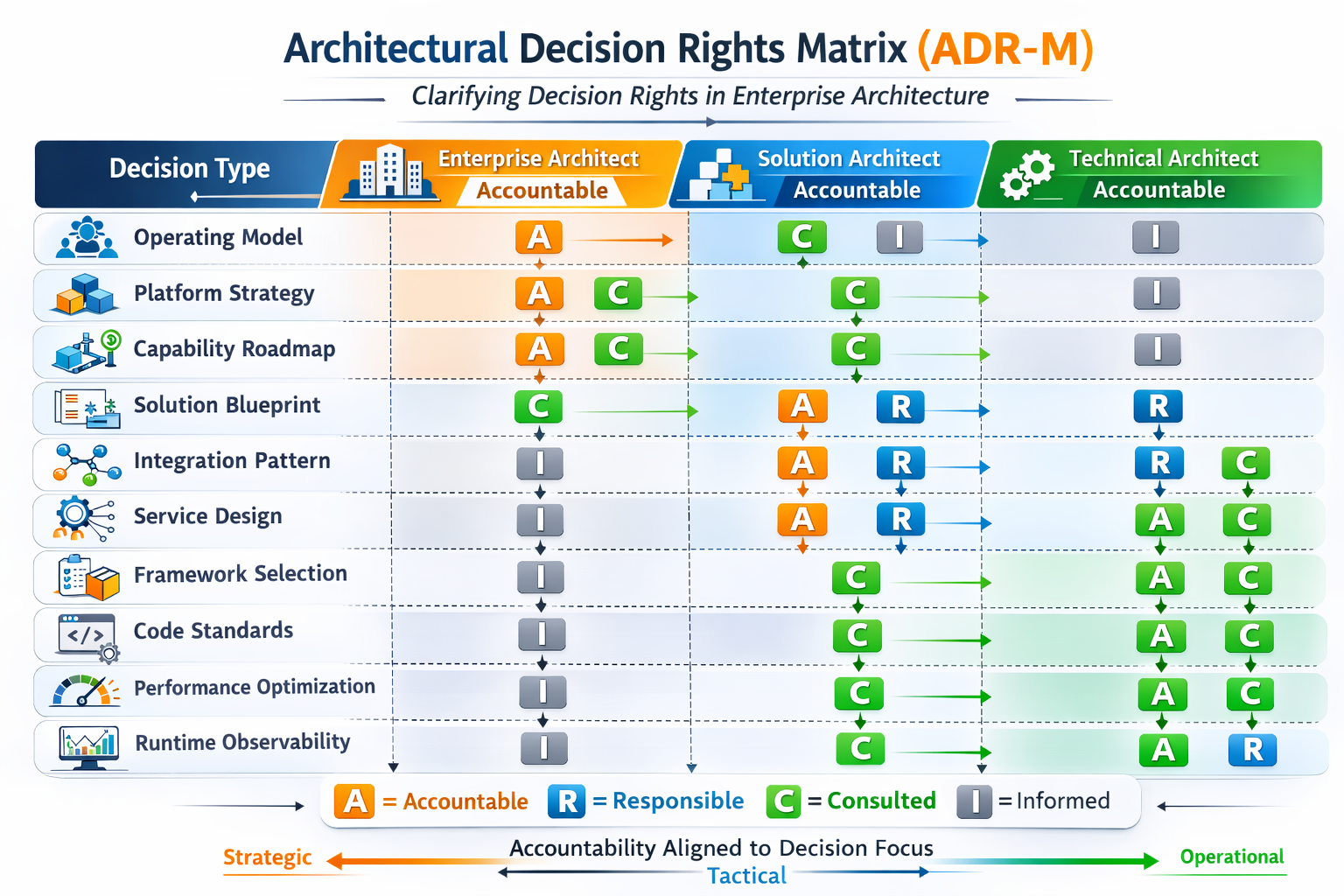
The ADR-M defines decision accountability by architectural altitude.
- A — Accountable
- R — Responsible
- C — Consulted
- I — Informed
Strategic & Structural Decisions
| Decision Type | Enterprise Architect | Solution Architect | Technical Architect |
|---|---|---|---|
| Operating Model | A | C | I |
| Capability Map | A | C | I |
| Platform Strategy | A | C | I |
| Cloud & AI Posture | A | C | I |
| Governance Principles | A | C | I |
Strategic decisions shape the environment.
They cannot be delegated downward.
System & Initiative Decisions
| Decision Type | Enterprise Architect | Solution Architect | Technical Architect |
|---|---|---|---|
| Solution Blueprint | C | A | R |
| Integration Pattern | C | A | R |
| Service Boundaries | I | A | R |
| Data Flow Design | C | A | R |
| Resilience Mechanism | C | A | R |
Structural instability occurs when this layer is bypassed.
Implementation & Runtime Decisions
| Decision Type | Enterprise Architect | Solution Architect | Technical Architect |
|---|---|---|---|
| Framework Selection | I | C | A |
| Code Standards | I | C | A |
| CI/CD Design | I | C | A |
| Performance Optimization | I | C | A |
| Observability Implementation | I | C | A |
Execution quality must not redefine enterprise climate.
It must operate within defined constraints.
Why This Matters
When accountability is unclear:
- Duplicate platforms emerge
- Architectural reviews become political
- Delivery slows
- Governance weakens
- Technical debt accelerates
When altitude is respected:
- Decisions accelerate
- Escalations reduce
- Risk is visible
- Authority is structured
Architecture becomes stable under load.
The Governance Principle
Architecture fails when layers override each other.
Enterprise defines climate.
Solution defines structure.
Technical ensures integrity.
No layer replaces another.
They reinforce each other.
This is not hierarchy.
It is layered accountability aligned to risk altitude.
Implementation Guide (30 Days)
Phase 1: Decision Inventory (Weeks 1–2)
- List recurring architectural decisions
- Categorize by altitude (Strategic, Structural, Execution)
- Identify current decision owners
- Document misalignment cases
Deliverable: Decision Inventory Map
Phase 2: Authority Alignment (Weeks 3–4)
- Assign Accountable role per decision category
- Introduce ADR (Architecture Decision Record) template
- Define escalation boundaries
- Communicate matrix organization-wide
Deliverable: Architectural Decision Rights Matrix (ADR-M)
Evidence from Practice
Organizations that lack decision rights clarity experience:
- Architectural review fatigue
- Repeated governance debates
- Inconsistent technology choices
- Slower program delivery
Organizations that institutionalize ADR-M experience:
- Faster architectural approvals
- Reduced cross-role conflict
- Clear accountability
- Stronger governance confidence
Clarity reduces friction.
Friction reduction improves execution predictability.
Action Plan
This Week
Ask:
- Who is accountable for platform strategy?
- Who approves solution-level integration patterns?
- Who has final authority over framework selection?
If answers are inconsistent,
your governance is fragile.
Next 30 Days
Establish:
- Formal Architectural Decision Rights Matrix
- ADR documentation discipline
- Cross-altitude review checkpoints
- Escalation boundaries
Architecture must be governed.
Not negotiated repeatedly.
Final Thought
Enterprise Architects define the environment.
Solution Architects design within constraints.
Technical Architects ensure execution integrity.
Stability does not come from more meetings.
It comes from codified authority.
Architecture succeeds when altitude is respected and governance protects structural boundaries.
Next Step
If your organization struggles with architectural decision conflicts or unclear accountability:
→ Book a 30-minute strategy consultation
Clarity at altitude creates stability at scale.